
.post-text h1{color:#1F3143;font-weight:800;line-height:1.2;margin:0 0 .4em;} .post-text h2{color:#F39C12;font-weight:800;margin:1.6em 0 .5em;} .post-text h3{color:#1F3143;font-weight:700;margin:1.2em 0 .4em;} .post-text p a,.post-text li a{color:#008B8D;text-decoration:underline;font-weight:600;} .post-text p a:hover,.post-text li a:hover{color:#F39C12;} .post-text .am-summary{background:#f0f6fa;border-left:4px solid #00B7B9;padding:14px 18px;border-radius:8px;margin:0 0 1.2em;} .post-text ul{margin:0 0 1.1em 1.2em;} .post-text li{margin:.3em 0;} .post-text .wp-block-details{background:#fafbfc;border:1px solid #e3e8ee;border-left:4px solid #F39C12;border-radius:8px;padding:10px 18px;margin:0 0 .7em;} .post-text .wp-block-details summary{cursor:pointer;font-weight:700;color:#1F3143;list-style-position:inside;} .post-text .wp-block-details[open] summary{color:#F39C12;} .post-text .wp-block-details summary::marker{color:#F39C12;}
How to Measure a Roof for Shingles (Step by Step)
Quick summary: To measure a roof for shingles, measure each roof plane, total the area, apply the pitch factor, then convert the area to roofing squares and shingle bundles with a waste allowance.
How to measure a roof for shingles comes down to one simple chain. You measure each roof plane, then add them up for the total area. You apply the pitch factor so steep slopes are counted right. Then you turn that area into roofing squares, and squares into shingle bundles. This guide walks every step in plain terms. It covers the square footage math, how to work from the ground, and the materials to order. By the end, you can order shingles with confidence.
What You’ll Need
You do not need much to measure a roof for shingles. A few basic tools cover most jobs.
- A tape measure or a measuring wheel for the planes.
- A pen and paper, or a phone, for your sketch.
- A calculator for the area, squares, and bundles.
- A ladder only if you plan to measure on the roof.
- Your roof pitch, read from the ground or on the roof.
You can also skip the tools and order a report from your address. Either path gets you to the same bundle count.
How to Measure a Roof for Shingles
The method is the same on every roof. You measure each plane, total the area, then convert it to shingle bundles. Here are the five steps in order.
Step 1: Sketch the roof and number each plane
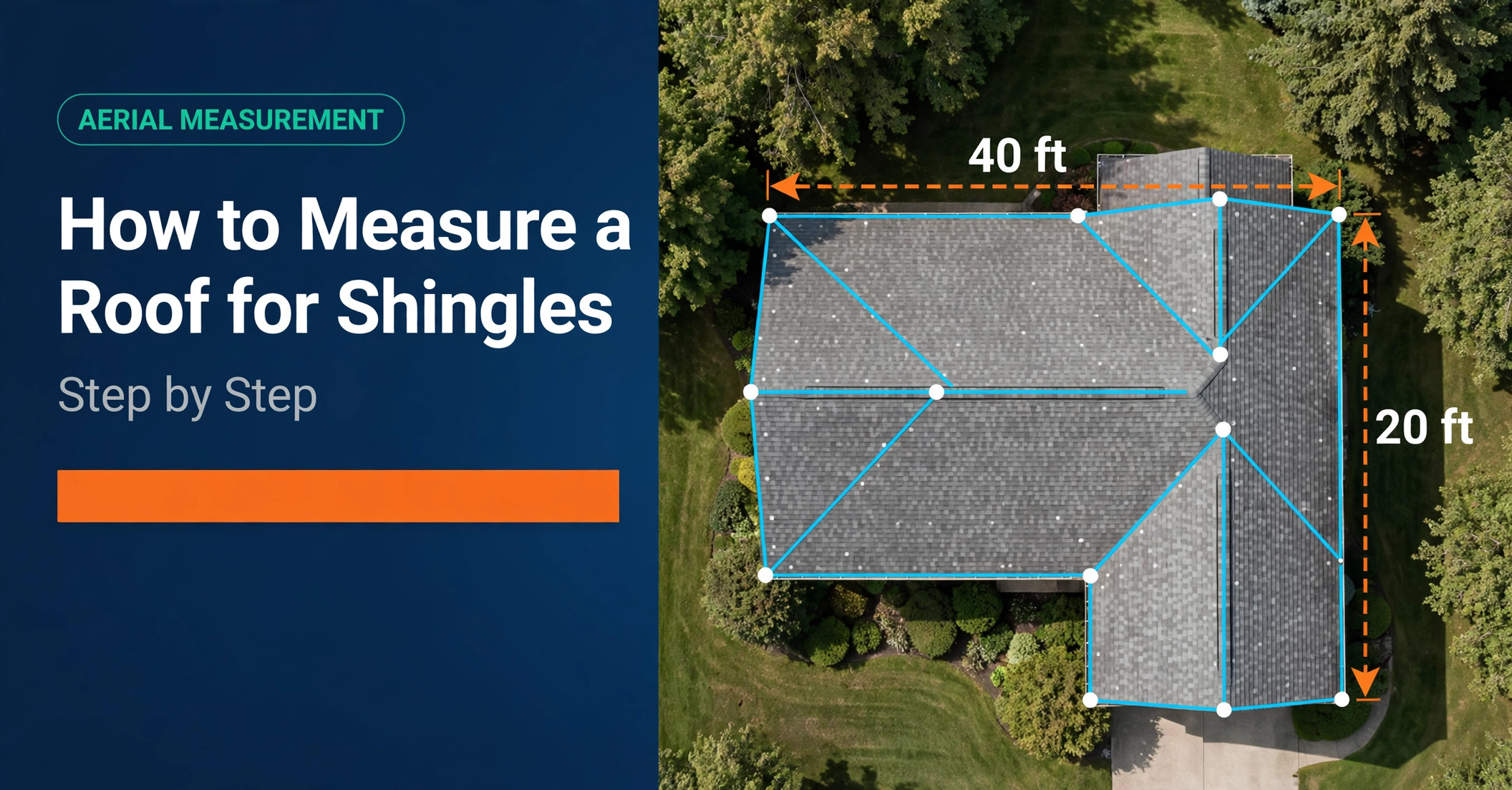
Start with a simple sketch of the roof from above. Draw every flat face, called a plane, as its own shape. Keep it rough, but keep the shapes accurate. Number each plane so you do not miss one. A plane can be a rectangle, a triangle, or a trapezoid. Mark where hips, valleys, and dormers sit. This sketch becomes your map for the whole job. A clear map now saves mistakes later, when you count materials.
Step 2: Measure the length and width of each plane
Next, measure the length and width of each plane in feet. Work across the roof in the same order as your sketch. For a rectangle, length times width gives the area. For a triangle, use one half times base times height. Write each measurement on the matching shape. Measure twice where a plane is cut up or odd. Small errors add up fast across a full roof. Accurate plane sizes are the base of every later step.
Step 3: Find the pitch and apply the slope factor
A roof is not flat, so its real surface is bigger than its footprint. That extra size comes from the pitch, or how steep the roof is. You find the pitch, then multiply each plane by its slope factor. A low slope adds little, while a steep slope adds a lot. Apply the factor to every plane before you total the area. Skip this step, and your shingle count will fall short.
Step 4: Add the planes for total roof area
Now add the area of every plane together. This total is the full roof area in square feet. Include each plane, even the small ones over porches. Double-check that no face from your sketch is left out. Write the total at the top of your sketch. The total area drives your square and bundle counts. One missed plane means too few shingles on the truck. Take a minute to confirm the sum before you move on.
Step 5: Convert area to squares, then to shingle bundles
Roofers order shingles by the square, not the square foot. One roofing square equals 100 square feet of roof. Divide your total area by 100 to get your squares. Most shingles need about three bundles to cover one square. Multiply your squares by three for a rough bundle count. Then add waste for cuts, hips, and valleys. A common waste allowance runs from 10 to 15 percent. This gives you a bundle count you can actually order from.
A quick worked example
Say a simple gable roof has two planes. Each plane measures 40 feet by 20 feet. That is 800 square feet per plane, flat. Two planes give 1,600 square feet of footprint. The roof has a medium slope, so apply a 1.12 factor. That brings the true area to about 1,792 square feet. Divide by 100 for roughly 18 squares. At three bundles each, plan about 54 bundles. Add 15 percent waste, so order around 62 bundles.
How to Calculate Roof Square Footage
To calculate roof square footage, you measure each plane and adjust for the slope. Here is the short version.
- Measure the length and width of each roof plane in feet.
- For rectangles, multiply length by width to get the flat area.
- For triangles, take one half of the base times the height.
- Add every plane together for the flat footprint area.
- Multiply the footprint by the pitch factor for true sloped area.
- The result is your total roof square footage.
This is how you determine roof square footage for any shingle job.
How to Figure Roofing Squares and Shingle Bundles
Once you know your square footage, roofing squares and bundles are quick to figure.
- One roofing square equals 100 square feet of roof.
- Divide your total square footage by 100 to get your squares.
- So a 2,000 square foot roof is 20 squares.
- Plan about three bundles of shingles per square.
- Add 10 to 15 percent for waste on cuts and valleys.
- This tells you how many bundles of shingles you need.
How to Measure a Roof From the Ground (Without Climbing)
You can measure a roof from the ground when climbing is unsafe or slow. Getting on a roof carries a real fall risk, so skip it when you can.
- Measure the building footprint from the ground, wall to wall.
- Count courses or use a photo to estimate the pitch.
- Apply the pitch factor to turn footprint into sloped area.
- Convert that area to squares and bundles as above.
- Use this for a fast bid, then confirm before you order.
Many professionals measure roofs this way, without climbing at all. It is the quickest way to measure a roof for a bid.
How Much Roofing Material You Need
Shingles are only part of the order, so plan the full material list from your squares.
- Field shingles: about three bundles per square, plus waste.
- Starter shingles: measured along the eaves and rakes.
- Ridge cap shingles: measured along the ridges and hips.
- Underlayment or felt: ordered by the square, like shingles.
- Roofing nails: counted per square, based on the shingle type.
Your square count drives every item on this list. This is how you measure for roofing materials, not just shingles.
The Easy Way: Skip the Math
All of this works, but it takes time and a steady hand. There is a faster way that needs no ladder and no math. An aerial roof measurement report measures your roof from its address. It returns the exact area, squares, and bundle counts for you. You can read what aerial roof measurement is before you order. The report shows every number in one place, ready to bid. See what goes into a roof measurement report, then order a roof measurement report for any property.
Common Mistakes to Avoid
A few common mistakes throw off a shingle count more than anything else.
- Measuring only the footprint and forgetting the pitch factor.
- Ordering by square feet instead of roofing squares.
- Leaving out waste for cuts, hips, and valleys.
- Missing small planes over porches, dormers, or garages.
- Rounding down when you should round up on bundles.
The Bottom Line
Measuring a roof for shingles is just one clear chain. You measure each plane, total the area, then adjust for pitch. You turn that area into squares, and squares into bundles with waste. Add the rest of your materials from the same square count. Work from the ground when the roof is steep or risky. When you want exact numbers without the math, an aerial report does it from an address. Either way, you can now order shingles with confidence.
Frequently Asked Questions
How many bundles of shingles do I need for a roof?
Most roofs need about three bundles of shingles per square. First find your squares, which is your roof area divided by 100. Then multiply your squares by three for a base bundle count. Add 10 to 15 percent for waste before you order.
How many square feet is a square of shingles?
One square of shingles covers 100 square feet of roof. It is the standard unit roofers use to order shingles. To find your squares, divide your total roof area by 100.
How much extra should I add for waste?
A waste allowance of 10 to 15 percent works for most roofs. Simple gable roofs sit near the low end. Roofs with many hips and valleys need the higher end. Waste covers cuts, starter, and mistakes, so do not skip it.
Can I measure a roof for shingles without getting on it?
Yes, you can measure a roof for shingles from the ground. You measure the footprint, estimate the pitch, then apply the slope factor. For exact numbers, an aerial report measures the roof from its address. Both options skip the ladder and the fall risk.
How do I measure a roof for shingles from the ground?
Measure the building footprint wall to wall at ground level. Estimate the roof pitch from the ground or a clear photo. Apply the pitch factor to turn the footprint into sloped area. Then convert that area into squares and shingle bundles.
{“@context”: “https://schema.org”, “@type”: “FAQPage”, “mainEntity”: [{“@type”: “Question”, “name”: “How many bundles of shingles do I need for a roof?”, “acceptedAnswer”: {“@type”: “Answer”, “text”: “Most roofs need about three bundles of shingles per square. First find your squares, which is your roof area divided by 100. Then multiply your squares by three for a base bundle count. Add 10 to 15 percent for waste before you order.”}}, {“@type”: “Question”, “name”: “How many square feet is a square of shingles?”, “acceptedAnswer”: {“@type”: “Answer”, “text”: “One square of shingles covers 100 square feet of roof. It is the standard unit roofers use to order shingles. To find your squares, divide your total roof area by 100.”}}, {“@type”: “Question”, “name”: “How much extra should I add for waste?”, “acceptedAnswer”: {“@type”: “Answer”, “text”: “A waste allowance of 10 to 15 percent works for most roofs. Simple gable roofs sit near the low end. Roofs with many hips and valleys need the higher end. Waste covers cuts, starter, and mistakes, so do not skip it.”}}, {“@type”: “Question”, “name”: “Can I measure a roof for shingles without getting on it?”, “acceptedAnswer”: {“@type”: “Answer”, “text”: “Yes, you can measure a roof for shingles from the ground. You measure the footprint, estimate the pitch, then apply the slope factor. For exact numbers, an aerial report measures the roof from its address. Both options skip the ladder and the fall risk.”}}, {“@type”: “Question”, “name”: “How do I measure a roof for shingles from the ground?”, “acceptedAnswer”: {“@type”: “Answer”, “text”: “Measure the building footprint wall to wall at ground level. Estimate the roof pitch from the ground or a clear photo. Apply the pitch factor to turn the footprint into sloped area. Then convert that area into squares and shingle bundles.”}}]}