
.post-text h1{color:#1F3143;font-weight:800;line-height:1.2;margin:0 0 .4em;} .post-text h2{color:#F39C12;font-weight:800;margin:1.6em 0 .5em;} .post-text h3{color:#1F3143;font-weight:700;margin:1.2em 0 .4em;} .post-text p a,.post-text li a{color:#008B8D;text-decoration:underline;font-weight:600;} .post-text p a:hover,.post-text li a:hover{color:#F39C12;} .post-text .am-summary{background:#f0f6fa;border-left:4px solid #00B7B9;padding:14px 18px;border-radius:8px;margin:0 0 1.2em;} .post-text ul{margin:0 0 1.1em 1.2em;} .post-text li{margin:.3em 0;} .post-text .wp-block-table{margin:0 0 1.3em;} .post-text .wp-block-table table{border-collapse:collapse;width:100%;} .post-text .wp-block-table th{background:#1F3143;color:#fff;font-weight:700;padding:9px 12px;text-align:left;} .post-text .wp-block-table td{padding:8px 12px;border-bottom:1px solid #e3e8ee;} .post-text .wp-block-table.is-style-stripes tbody tr:nth-child(odd) td{background:#f6f8fa;} .post-text .wp-block-details{background:#fafbfc;border:1px solid #e3e8ee;border-left:4px solid #F39C12;border-radius:8px;padding:10px 18px;margin:0 0 .7em;} .post-text .wp-block-details summary{cursor:pointer;font-weight:700;color:#1F3143;list-style-position:inside;} .post-text .wp-block-details[open] summary{color:#F39C12;} .post-text .wp-block-details summary::marker{color:#F39C12;}
How to Measure Roof Pitch (Step by Step)
Quick summary: Roof pitch is the rise of a roof over 12 inches of run, written like 6/12. Measure it with a level, a speed square, from the attic, or from the ground, then turn it into a slope factor for true roof area.
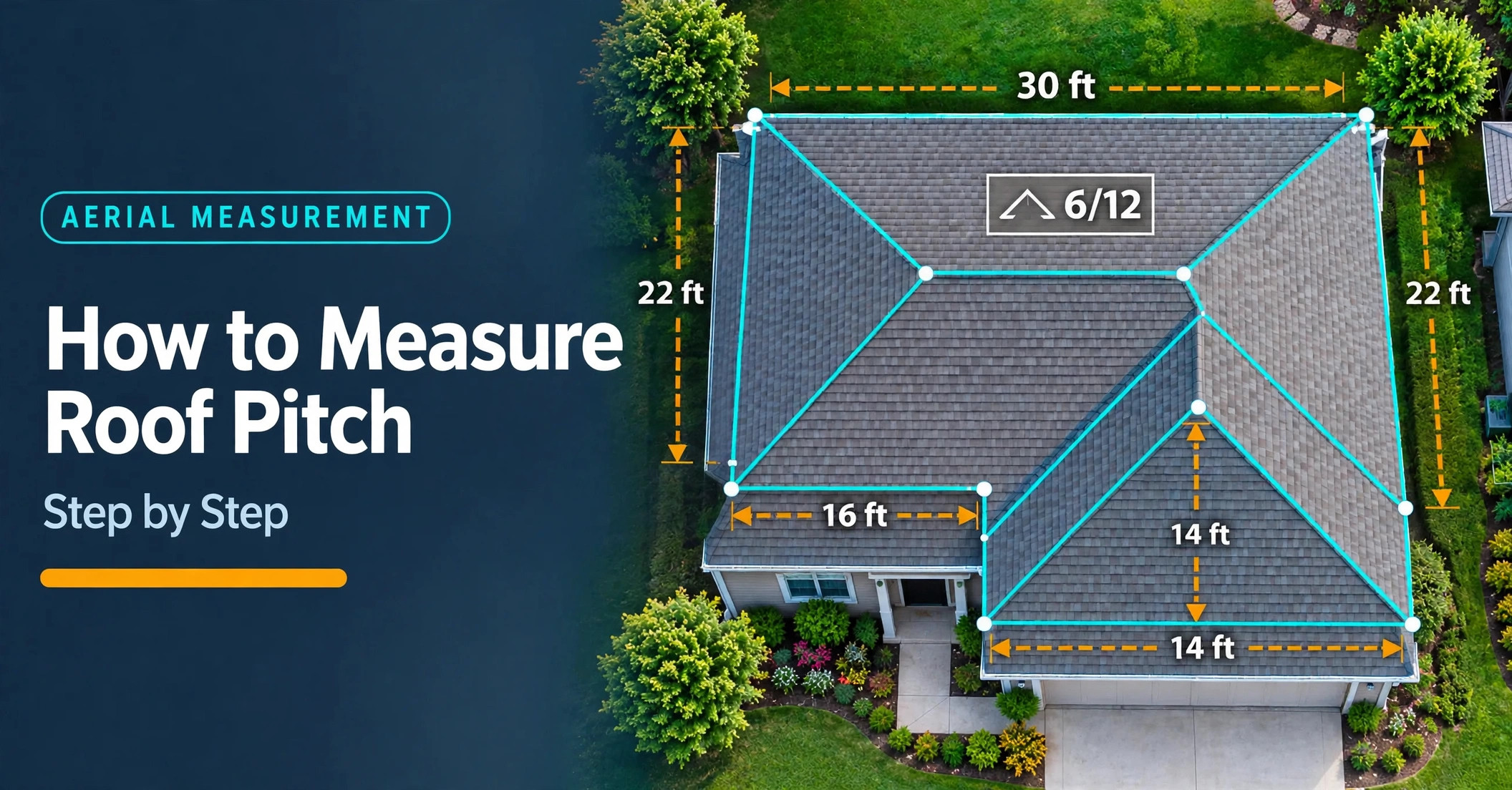
Learning how to measure roof pitch is simple once you know the rule. Pitch is the rise of the roof over 12 inches of run. You write it as a ratio, like 6/12, which means 6 inches of rise per foot. You can measure it with a level, a speed square, from the attic, or from the ground. This guide covers each method in plain steps. It also explains what the number means and how to turn it into roof area.
What Roof Pitch Means
Roof pitch is a measure of how steep a roof is, written as rise over run. Roofers use the standard rise-over-run ratio as the base of every method below.
- Pitch is the inches of rise for every 12 inches of run.
- It is written as a ratio, like 4/12, 6/12, or 12/12.
- Slope and pitch mean the same thing on steep-slope roofs.
- The same pitch can also be shown as an angle in degrees.
Pitch matters for more than looks. It decides how much material a roof needs and which coverings work. A steep roof has more surface than its footprint suggests. That is why pitch feeds directly into any area or material estimate.
How to Measure Roof Pitch
The fastest way to measure roof pitch is with a level and a tape. You hold the level flat, then measure the rise at 12 inches of run. There are four easy methods, so pick the one that fits your roof.
Method 1: With a level and tape measure
This method gives a direct, accurate pitch reading. You can do this on the roof or on a gable end. Rest one end of a level against the roof surface. Hold it dead level, then measure up 12 inches along it. At that 12-inch mark, measure straight down to the roof. That drop is your rise, over a 12-inch run. A 6-inch drop means a 6/12 pitch. Take care on the roof, since a fall is a real risk.
Method 2: With a speed square
A speed square reads pitch fast, with no math. Set the square on edge against a rafter or the roof slope. Put the pivot point on the top edge and let the square hang level. Read where the roof line crosses the degree or pitch scale. Many speed squares show common pitches right on the tool. This is the quickest on-roof read for most roofers. It works best when the square sits flush and steady.
Method 3: From inside the attic
You can measure pitch in the attic, with no outside climbing. Pick a spot where a rafter meets the ridge or a joist. Hold a level out from the rafter and keep it flat. Measure up 12 inches along the level, then down to the rafter. That rise over a 12-inch run is your pitch. This is a safe way to get an accurate number. It suits steep or wet roofs that are unsafe to climb.
Method 4: From the ground or a photo
You can also estimate pitch from the ground, with no ladder. Stand back and hold a level against a clear side view of the roof. Measure the rise over 12 inches of run, just as above. A clear side-on photo of the roof works the same way. Some smartphone apps read pitch from a photo or the phone’s sensors. Satellite and aerial methods can also read pitch from above. A ground estimate is close, but confirm it before a final order.
Which method should you use?
Pick by access and safety, not habit. Use the speed square or level if you are already on the roof. Choose the attic method when the roof is steep or wet. Use the ground or photo method for a quick bid from below. When you need exact numbers, an aerial report removes the guesswork.
Roof Pitch to Slope Factor
Once you know your pitch, you can turn it into a slope factor. The slope factor is a roof pitch multiplier that accounts for the slope. You multiply the flat footprint by this factor to get true roof area. The table below lists the angle and slope factor for common pitches. Use it when you measure a roof for shingles and need the area.
| Pitch (x/12) | Angle (degrees) | Slope factor |
|---|---|---|
| 3/12 | 14.0 | 1.031 |
| 4/12 | 18.4 | 1.054 |
| 5/12 | 22.6 | 1.083 |
| 6/12 | 26.6 | 1.118 |
| 7/12 | 30.3 | 1.158 |
| 8/12 | 33.7 | 1.202 |
| 9/12 | 36.9 | 1.250 |
| 10/12 | 39.8 | 1.302 |
| 11/12 | 42.5 | 1.357 |
| 12/12 | 45.0 | 1.414 |
Here is how the factor works in practice. Say a roof footprint covers 2,000 square feet. The pitch is 6/12, so the slope factor is 1.118. You multiply 2,000 by 1.118 to get about 2,236 square feet. That larger number is the true roof area to order from. A steeper 12/12 roof would use 1.414 instead. The same footprint would then cover about 2,828 square feet.
Common Roof Pitches
Roof pitches fall into three broad groups. Knowing the group helps you plan materials and safety.
- Low-slope roofs sit below about 3/12 and often need special coverings.
- Most asphalt shingles need a minimum pitch near 2/12.
- Conventional roofs run about 4/12 to 9/12, the most common range.
- A 4/12 to 6/12 pitch is a common, standard choice on homes.
- Steep-slope roofs are 10/12 and up, and are hard to walk.
Pitch also affects how safe a roof is to walk. Low and conventional pitches are easier to stand on. Steep roofs need extra care, ropes, or a lift. On those roofs, the attic or ground method is the smart call.
Put Your Pitch to Work
Your pitch is only useful once you apply it. Multiply the roof footprint by the slope factor to get true area. From there, you can order shingles and other materials. If you would rather skip the measuring, there is an easier way. You can read what aerial roof measurement is before you start. An aerial report reads the pitch and returns the area from an address. To get one, order a roof measurement report for any property.
Common Mistakes and Safety
A few simple mistakes throw off a pitch reading.
- Measuring the run instead of the rise.
- Forgetting to use a 12-inch base for the run.
- Reading a speed square upside down or off-angle.
- Trusting a rough ground estimate for a final material order.
- Climbing a wet or steep roof without fall protection.
The Bottom Line
Measuring roof pitch comes down to rise over run. You find the inches of rise for every 12 inches of run. You can do it with a level, a speed square, from the attic, or from the ground. Then you turn that pitch into a slope factor for true roof area. Pick the method that is safest and easiest for your roof. With the pitch in hand, your next material order gets a lot more accurate.
Frequently Asked Questions
Do I still need to measure pitch if I order an aerial report?
No. An aerial report reads the pitch for you and returns the roof area from the address.
How accurate is measuring roof pitch from the ground?
It is a solid estimate, but not exact. Confirm it with an on-roof, attic, or aerial reading before a final order.
Can one roof have more than one pitch?
Yes. Many roofs mix pitches across sections, so measure each slope on its own.
Which method gives the most accurate pitch?
A level or speed square used on the roof or a rafter is most accurate. Ground and app estimates are faster but looser.
What if my roof is too steep or unsafe to measure?
Use the attic method, or get an aerial report. Both give you the pitch with no climbing.
{“@context”: “https://schema.org”, “@type”: “FAQPage”, “mainEntity”: [{“@type”: “Question”, “name”: “Do I still need to measure pitch if I order an aerial report?”, “acceptedAnswer”: {“@type”: “Answer”, “text”: “No. An aerial report reads the pitch for you and returns the roof area from the address.”}}, {“@type”: “Question”, “name”: “How accurate is measuring roof pitch from the ground?”, “acceptedAnswer”: {“@type”: “Answer”, “text”: “It is a solid estimate, but not exact. Confirm it with an on-roof, attic, or aerial reading before a final order.”}}, {“@type”: “Question”, “name”: “Can one roof have more than one pitch?”, “acceptedAnswer”: {“@type”: “Answer”, “text”: “Yes. Many roofs mix pitches across sections, so measure each slope on its own.”}}, {“@type”: “Question”, “name”: “Which method gives the most accurate pitch?”, “acceptedAnswer”: {“@type”: “Answer”, “text”: “A level or speed square used on the roof or a rafter is most accurate. Ground and app estimates are faster but looser.”}}, {“@type”: “Question”, “name”: “What if my roof is too steep or unsafe to measure?”, “acceptedAnswer”: {“@type”: “Answer”, “text”: “Use the attic method, or get an aerial report. Both give you the pitch with no climbing.”}}]}